Tale of two flags.
The Union Jack and the Stars and Stripes.

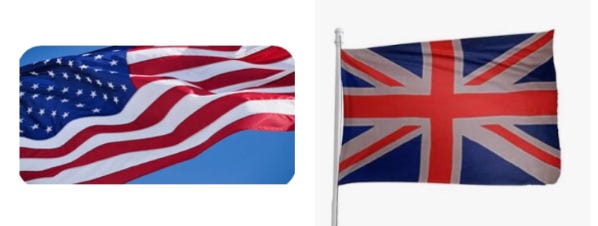
This article is about the two most recognizable and iconic national flags in the world, and the history that surrounds them.
I love them both, but for different reasons.
The Union Jack - I was born under the Union Jack, but in an African colony, Southern Rhodesia, in 1959. However, the colony rebelled against British rule and declared unilateral independence (UDI) in 1964. So my stay as a British citizen was short lived at best. In fact I grew up to not be happy with Britain because they they rewarded our devotion and loyalty to the crown by giving away Southern Rhodesia to the nationalist communists and the country became Zimbabwe.

The United Kingdom was the greatest empire the world has ever known, and it’s flag flew around the world.
Anyway, in 1980, I left Zimbabwe and emigrated to the United States of America, specifically to California. I became a citizen, and pledged alliegence to the U.S. flag. I love this country, and this flag.

Probably the most recognizable and iconic flag in the world today.

here is the history and tale of the two flags:
The U.S. flag evolved from a wartime banner to a global symbol, representing the country’s growth from 13 colonies to 50 states. Its design and star count have been updated periodically, with the final addition taking place in 1960.
Key Milestones in the Flag’s History:
1775 - Early colonial forces used the Grand Union Flag, which featured thirteen stripes alongside the British Union Jack in the upper left corner.
1777 - (Flag Act): On June 14, 1777, the Continental Congress passed the first Flag Resolution, officially establishing a unified flag. It mandated 13 stripes and 13 stars to represent the colonies. Today, this date is celebrated as Flag Day.
1795 - Following the admission of Vermont and Kentucky, Congress mandated that the flag have 15 stripes and 15 stars. This exact 15-stripe flag, flying over Fort McHenry in 1814, inspired Francis Scott Key to write “The Star-Spangled Banner”.
1818 - With the nation rapidly expanding, adding a new stripe for every state became impractical. The Flag Act of 1818 permanently reverted the stripes to the original 13 and mandated that a new star be added for each new state.
1912 - President William H. Taft issued an executive order standardizing the flag’s proportions and arranging the stars into orderly rows.
1960 - The admission of Hawaii brought the total star count to 50, resulting in the design used today.
Color Symbolism: while the colors were not assigned specific meanings in 1777, they were later given symbolic meaning by the U.S. government:Red: Valor and HardinessWhite: Purity and InnocenceBlue: vigilance and justice.
The national flag of the United States, often referred to as the American flag or the U.S. flag, consists of thirteen horizontal stripes, alternating red and white, with a blue rectangle in the canton bearing fifty small, white, five-pointed stars arranged in nine offset horizontal rows, where rows of six stars alternate with rows of five stars. The 50 stars on the flag form a constellation, representing the 50 U.S. states united, while the 13 stripes represent the thirteen colonies that won independence from Great Britain in the American war of independence.
The civil war:
The flag was created as an item of military equipment to identify U.S. ships and forts. It evolved gradually during early American history, and was not designed by any one person. The flag exploded in popularity in 1861 as a symbol of opposition to the Confederate attack on Fort Sumter. It came to symbolize the Union in the American Civil War; Union victory solidified its status as a national flag. Because of the country’s emergence as a superpower in the 20th century, the flag is now among the most widely recognized symbols in the world.
Well-known nicknames for the flag include “the Stars and Stripes”, “Old Glory”, “the Star-Spangled Banner”, and “the Red, White and Blue”. The Pledge of Allegiance and the holiday Flag Day are dedicated to it. The number of stars on the flag is increased as new states join the United States. The last adjustment was made in 1960, following the admission of Hawaii.
The first official flag resembling the “Stars and Stripes” was the Continental Navy ensign (often referred to as the Continental Union Flag, Continental Colours, the first American flag, Cambridge Flag, and Grand Union Flag) was used from 1775 to 1777. It consisted of 13 red-and-white stripes, with the British Union Flag in the canton. It first appeared on December 3, 1775, when Continental Navy Lieutenant John Paul Jones flew it aboard Captain Esek Hopkins’ flagship Alfred on the Delaware River.
Prospect Hill was the location of George Washington’s command post during the Siege of Boston during the American Revolution. On New Year’s Day in 1776, Washington conducted a flag-raising ceremony to raise the morale of the men of the Continental Army. The Continental Union Flag remained the national flag until June 14, 1777. At the time of the Declaration of Independence in July 1776, there were no flags with any stars on them; the Continental Congress did not adopt flags with “stars, white in a blue field” for another year. It has historically been referred to as the first flag of the United States.
Colloquially referred to as the Cambridge Flag and Grand Union Flag; the terms domain did not come into use until the 19th century. Although it has been claimed the more recent moniker, Grand Union Flag, was first applied to the Continental Union Flag by G. Henry Preble in his Reconstruction era book Our Flag; the first substantiated use of the name came from Philadelphia resident T. Westcott in 1852 when replying to an inquiry made in Notes and Queries, a London periodical, as to the origin of the U.S. flag.
The flag of the East India Company, introduced in 1707 and flown at sea in the Indian Ocean

The flag very closely resembles the East India Company flag of the era. Sir Charles Fawcett argued in 1937 that the company flag inspired the design of the U.S. flag. Both flags could easily have been constructed by adding white stripes to a Red Ensign, one of the three maritime flags used throughout the British Empire at the time. However, the East India Company flag could have from nine to 13 stripes and was not allowed to be flown outside the Indian Ocean.
Benjamin Franklin once gave a speech endorsing the adoption of the East India Company flag by the United Colonies. He said to George Washington, “While the field of your flag must be new in the details of its design, it need not be entirely new in its elements. There is already in use a flag, I refer to the flag of the East India Company.” This was a way of symbolizing American loyalty to the Crown as well as the colonies’ aspirations to be self-governing, as was the East India Company.
The theory that the Continental Union Flag was a direct descendant of the East India Company flag has been criticized as lacking written evidence; on the other hand, the resemblance to the company flag is obvious, and some of the Founding Fathers of the United States were aware of the East India Company’s activities and of their free administration of India under Company rule.
Flag Resolution of 1777
On June 14, 1777, the Continental Congress passed the Flag Resolution which stated: “Resolved, That the flag of the thirteen United States be thirteen stripes, alternate red and white; that the union be thirteen stars, white in a blue field, representing a new constellation.”Flag Day is now observed on June 14 of each year. While scholars still argue about this, tradition holds that the new flag was first hoisted in June 1777 by the Continental Army at the Middlebrook encampment.
Another widely repeated theory is that the design was inspired by the coat of arms of George Washington’s family, which includes three red stars over two horizontal red bars on a white field. Despite the similar visual elements, there is “little evidence” or “no evidence whatsoever” to support the claimed connection with the flag design. The Digital Encyclopedia of George Washington, published by the Fred W. Smith National Library for the Study of George Washington at Mount Vernon, calls it an “enduring myth” backed by “no discernible evidence”. The story seems to have originated with the 1876 play Washington: A Drama in Five Acts, by the English poet Martin Farquhar Tupper, and was further popularized through repetition in the children’s magazine St. Nicholas.
The first official U.S. flag flown during battle was on August 3, 1777, at Fort Schuyler (Fort Stanwix) during the Siege of Fort Stanwix. Massachusetts reinforcements brought news of the adoption by Congress of the official flag to Fort Schuyler. Soldiers cut up their shirts to make the white stripes; scarlet material to form the red was secured from red flannel petticoats of officers’ wives, while material for the blue union was secured from Capt. Abraham Swartwout’s blue cloth coat. A voucher is extant that Congress paid Capt. Swartwout of Dutchess County for his coat for the flag.
The 1777 resolution was probably meant to define a naval ensign. In the late 18th century, the notion of a national flag did not yet exist or was only nascent. The flag resolution appears between other resolutions from the Marine Committee. On May 10, 1779, Secretary of the Board of War Richard Peters expressed concern that “it is not yet settled what is the Standard of the United States.” However, the term “Standard” referred to a national standard for the Army of the United States. Each regiment was to carry the national standard in addition to its regimental standard. The national standard was not a reference to the national or naval
Standard.
The Flag Resolution did not specify any particular arrangement, number of points, nor orientation for the stars and the arrangement or whether the flag had to have seven red stripes and six white ones or vice versa. The appearance was up to the maker of the flag. Some flag makers arranged the stars into one big star, in a circle or in rows and some replaced a state’s star with its initial. One arrangement features 13 five-pointed stars arranged in a circle, with the stars arranged pointing outwards from the circle (as opposed to up), the Betsy Ross flag. Experts have dated the earliest known example of this flag to be 1792 in a painting by John Trumbull.
Despite the 1777 resolution, the early years of American independence featured many different, hand-crafted flags. As late as 1779, Captain John Manley believed that the United States “had no national colors” so each ship flew whatever flag pleased the captain.
Some of the early flags included blue stripes as well as red and white. Benjamin Franklin and John Adams, in an October 3, 1778, letter to Ferdinand I of the Two Sicilies, described the American flag as consisting of “13 stripes, alternately red, white, and blue, a small square in the upper angle, next to the flagstaff, is a blue field, with 13 white stars, denoting a new Constellation.” John Paul Jones used a variety of 13-star flags on his U.S. Navy ships including the well-documented 1779 flags of the Serapis and the Alliance. The Serapis flag had three rows of eight-pointed stars with red, white, and blue stripes. However, the flag for the Alliance had five rows of eight-pointed stars with 13 red and white stripes, and the white stripes were on the outer edges. Both flags were documented by the Dutch government in October 1779, making them two of the earliest known flags of 13 stars.
Designer of the first stars and stripes
Francis Hopkinson of New Jersey, a naval flag designer and a signer of the Declaration of Independence, designed a flag in 1777 while he was the chairman of the Continental Navy Board’s Middle Department, sometime between his appointment to that position in November 1776 and the time that the flag resolution was adopted in June 1777. The Navy Board was under the Continental Marine Committee. Not only did Hopkinson claim that he designed the U.S. flag, but he also claimed that he designed a flag for the U.S. Navy. Hopkinson was the only person to have made such a claim during his own life when he sent a letter and several bills to Congress for his work. These claims are documented in the Journals of the Continental Congress and George Hasting’s biography of Hopkinson. Hopkinson initially wrote a letter to Congress, via the Continental Board of Admiralty, on May 25, 1780.[41] In this letter, he asked for a “Quarter Cask of the Public Wine” as payment for designing the U.S. flag, the seal for the Admiralty Board, the seal for the Treasury Board, Continental currency, the Great Seal of the United States, and other devices. However, in three subsequent bills to Congress, Hopkinson asked to be paid in cash, but he did not list his U.S. flag design. Instead, he asked to be paid for designing the “great Naval Flag of the United States” in the first bill; the “Naval Flag of the United States” in the second bill; and “the Naval Flag of the States” in the third, along with the other items. The flag references were generic terms for the naval ensign that Hopkinson had designed: a flag of seven red stripes and six white ones. The predominance of red stripes made the naval flag more visible against the sky on a ship at sea. By contrast, Hopkinson’s flag for the United States had seven white stripes and six red ones – in reality, six red stripes laid on a white background. Hopkinson’s sketches have not been found, but we can make these conclusions because Hopkinson incorporated different stripe arrangements in the Admiralty (naval) Seal that he designed in the Spring of 1780 and the Great Seal of the United States that he proposed at the same time. His Admiralty Seal had seven red stripes; whereas his second U.S. Seal proposal had seven white ones. Remnants of Hopkinson’s U.S. flag of seven white stripes can be found in the Great Seal of the United States and the President’s seal. The stripe arrangement would have been consistent with other flags of the period that had seven stripes below the canton, or blue area with stars. For example, two of the earliest known examples of Stars and Stripes flags were painted by a Dutch artist who witnessed the arrival of Navy Lieutenant John Paul Jones’ squadron in Texel, The Netherlands, in 1779. The two flags have seven stripes below the canton.
When Hopkinson was chairman of the Navy Board, his position was like that of today’s Secretary of the Navy. The payment was not made, most likely, because other people had contributed to designing the Great Seal of the United States, and because it was determined he already received a salary as a member of Congress. This contradicts the legend of the Betsy Ross flag, which suggests that she sewed the first Stars and Stripes flag at the request of the government in the Spring of 1776.
On May 10, 1779, a letter from the War Board to George Washington stated that there was still no design established for a national standard, on which to base regimental standards, but also referenced flag requirements given to the board by General von Steuben. On September 3, Richard Peters submitted to Washington “Drafts of a Standard” and asked for his “Ideas of the Plan of the Standard”, adding that the War Board preferred a design they viewed as “a variant for the Marine Flag”. Washington agreed that he preferred “the standard, with the Union and Emblems in the center.” The drafts are lost to history but are likely to be similar to the first Jack of the United States.
13-star Betsy Ross variant

The origin of the stars and stripes design has been muddled by a story disseminated by the descendants of Betsy Ross. The apocryphal story credits Betsy Ross for sewing one of the first flags from a pencil sketch handed to her by George Washington. No such evidence exists either in George Washington’s diaries or the Continental Congress’s records. Indeed, nearly a century passed before Ross’s grandson, William Canby, first publicly suggested the story in 1870. By her family’s own admission, Ross ran an upholstery business, and she had never made a flag as of the supposed visit in June 1776. Furthermore, her grandson admitted that his own search through the Journals of Congress and other official records failed to find corroborating evidence for his grandmother’s story.
George Henry Preble states in his 1882 text that no combined stars and stripes flag was in common use prior to June 1777, and that no one knows who designed the 1777 flag. Historian Laurel Thatcher Ulrich argues that there was no “first flag” worth arguing over. Researchers accept that the United States flag evolved, and did not have one design. Marla Miller writes, “The flag, like the Revolution it represents, was the work of many hands.”
The family of Rebecca Young claimed that she sewed the first flag. Young’s daughter was Mary Pickersgill, who made the Star-Spangled Banner Flag. She was assisted by Grace Wisher, a 13-year-old African American girl.
In 1795, the number of stars and stripes was increased from 13 to 15 (to reflect the entry of Vermont and Kentucky as states of the Union). For a time, the flag was not changed when subsequent states were admitted, probably because it was thought that this would cause too much clutter. It was the 15-star, 15-stripe flag that inspired Francis Scott Key to write “Defence of Fort M’Henry”, later known as “The Star-Spangled Banner”, which is now the American national anthem. The flag is currently on display in the exhibition “The Star-Spangled Banner: The Flag That Inspired the National Anthem” at the Smithsonian Institution National Museum of American History in a two-story display chamber that protects the flag while it is on view.
On April 4, 1818, a plan was passed by Congress at the suggestion of U.S. Naval Captain Samuel C. Reid in which the flag was changed to have 20 stars, with a new star to be added when each new state was admitted, but the number of stripes would be reduced to 13 so as to honor the original colonies. The act specified that new flag designs should become official on the first July 4 (Independence Day) following the admission of one or more new states.
In 1912, the 48-star flag was adopted. This was the first time that a flag act specified an official arrangement of the stars in the canton, namely six rows of eight stars each, where each star would point upward. The U.S. Army and U.S. Navy, however, had already been using standardized designs. Throughout the 19th century, different star patterns, both rectangular and circular, had been abundant in civilian use.
In 1960, the current 50-star flag was adopted, incorporating the most recent change, from 49 stars to 50, when the present design was chosen, after Hawaii gained statehood in August 1959. Before that, the admission of Alaska in January 1959 had prompted the debut of a short-lived 49-star flag.
Civil War and the flag
Prior to the Civil War, the American flag was rarely seen outside of military forts, government buildings and ships. This changed following the Battle of Fort Sumter in 1861. The flag flying over the fort was allowed to leave with the Union troops as they surrendered. It was taken across Northern cities, which spurred a wave of “Flagmania”. The Stars and Stripes, which had had no real place in the public conscious, suddenly became a part of the national identity. The flag became a symbol of the Union, and the sale of flags exploded at this time. Historian Adam Goodheart wrote:
For the first time American flags were mass-produced rather than individually stitched and even so, manufacturers could not keep up with demand. As the long winter of 1861 turned into spring, that old flag meant something new. The abstraction of the Union cause was transfigured into a physical thing: strips of cloth that millions of people would fight for, and many thousands die for.
In the Civil War, the flag was allowed to be carried into battle, reversing the 1847 regulation which prohibited this. (During the American Revolutionary War and War of 1812 the army was not officially sanctioned to carry the United States flag into battle. It was not until 1834 that the artillery was allowed to carry the American flag; the army would be granted to do the same in 1841. However, in 1847, in the middle of the war with Mexico, the flag was limited to camp use and not allowed to be brought into battle.) Some wanted to remove the stars of the states which had seceded but Abraham Lincoln was opposed, believing it would give legitimacy to the Confederate states.
Symbolism
The flag of the United States is the nation’s most widely recognized symbol. Within the United States, flags are frequently displayed not only on public buildings but on private residences. The flag is a common motif on decals for car windows, and on clothing ornamentation such as badges and lapel pins. Owing to the United States’s emergence as a superpower in the 20th century, the flag is among the most widely recognized symbols in the world, and is used to represent the United States.

The flag has become a powerful symbol of Americanism, and is flown on many occasions, with giant outdoor flags used by retail outlets to draw customers. Reverence for the flag has at times reached religion-like fervor: in 1919 William Norman Guthrie’s book The Religion of Old Glory discussed “the cult of the flag” and formally proposed vexillolatry.

Despite a number of attempts to ban the practice, desecration of the flag remains protected as free speech under the First Amendment to the United States Constitution. Scholars have noted the irony that “the flag is so revered because it represents the land of the free, and that freedom includes the ability to use or abuse that flag in protest”. Comparing practice worldwide, Testi noted in 2010 that the United States was not unique in adoring its banner, for the flags of Scandinavian countries are also “beloved, domesticated, commercialized and sacralized objects”.
Color symbolism
When the flag was officially adopted in 1777, the colors of red, white, and blue were not given an official meaning. However, when Charles Thomson, Secretary of the Continental Congress, presented a proposed U.S. seal in 1782, he explained its center section in this way:
The colours of the pales are those used in the flag of the United States of America; White signifies purity and innocence, Red, hardiness & valor, and Blue, the colour of the Chief signifies vigilance, perseverance & justice.
Flower wreath placed by Joe Biden at the John McCain Memorial Marker in Hanoi, designed with the three colors of the national flag.
These meanings have broadly been accepted as official, with some variation, but there are other extant interpretations as well:
Henry Ward Beecher said of the Fort Sumter Flag upon its 1865 return to the fort,
The stars that redeem the night from darkness, and the beams of red light that beautify the morning, have been united upon its folds. As long as the sun endures, or the stars, may it wave over a nation neither enslaved nor enslaving.
In 1986, president Ronald Reagan gave his own interpretation, saying,
The colors of our flag signify the qualities of the human spirit we Americans cherish. Red for courage and readiness to sacrifice; white for pure intentions and high ideals; and blue for vigilance and justice.
An interpretation attributed to George Washington claims that
We take the stars from heaven, the red from our mother country, separating it by white stripes, thus showing that we have separated from her, and the white stripes shall go down to posterity, representing our liberty.
The flag of the United Kingdom:
The Union Jack (or Union Flag) is the national flag of the United Kingdom. It represents the historic union of England, Scotland, and Ireland. The flag’s asymmetric design is formed by overlapping the individual patron saints’ crosses, evolving alongside the political unification of the British Isles over the centuries.The flag’s design evolved in three distinct stages:
1606 (Union of the Crowns): After King James VI of Scotland inherited the English throne to become James I of England, he sought a unified flag for both kingdoms. The original design combined the red Cross of St. George (England) with the white diagonal Saltire of St. Andrew (Scotland) on a blue field.
1707 (Act of Union): The Act of Union formally united the Parliaments of England and Scotland into the Kingdom of Great Britain. Queen Anne officially adopted the 1606 design as the new flag of the unified realm.
1801 (Act of Union): Following the Act of Union that joined Great Britain and Ireland, the red diagonal Cross of St. Patrick (Ireland) was added to the design. To adhere to strict heraldic rules—which state that no two symbols should appear equal in dominance—the diagonal saltires were counterchanged, giving Scotland precedence. This remains the present-day design of the flag.
Key Historical Details:The Name “Jack”: “Union Jack” originally referred specifically to small maritime flags flown on the jackstaff (at the bowsprit) of Royal Navy ships. By the late 17th century, the nickname became widely accepted for the flag both at sea and on land.
The Omission of Wales: Wales is not explicitly represented on the Union Jack because it was already annexed by England and considered an integral part of the English kingdom when the flag was first designed in 1642.
1606 (Royal decree)
1707 (National flag)
1801 (current design with St Patrick’s Saltire)

Design
Blue field on which the Cross of Saint Andrew, counterchanged with the Cross of Saint Patrick, over all the Cross of Saint George fimbriated.

Initially, the flag was termed the “British flag” or “flag of Britain”, and the term “Union” first appeared in 1625. The etymology of jack in the context of flagstaffs reaches back to Middle German. The suffix -kin was used in Middle Dutch and Middle German as a diminutive. Examples occur in both Chaucer and Langland though the form is unknown in Old English. John is a common male forename (going back to the Bible), appearing in Dutch as Jan. Both languages use it as a generic form for a man in general. The two were combined in the Middle Dutch Janke, whence Middle French Jakke and Middle English Jack. Jack came to be used to identify all manner of particularly small objects or small versions of larger ones. The Oxford English Dictionary has definition III.21 “Something insignificant, or smaller than the normal size” and gives examples from 1530 to 2014 of this usage. The original maritime flag use of jack was “A ship’s flag of a smaller size than the ensign, used at sea as a signal, or as an identifying device”. The jack was flown in the bows or from the head of the spritsail mast to indicate the vessel’s nationality: “You are alsoe for this present service to keepe in yor Jack at yor Boultspritt end and yor Pendant and yor Ordinance” The Union Flag when instantiated as a small jack became known as the “Union Jack” and this later term transferred to more general usage of the Union Flag
I personally like the Union Jack more. 🇬🇧🇬🇧🇬🇧. You have provided good information about these two flags.